Summary:
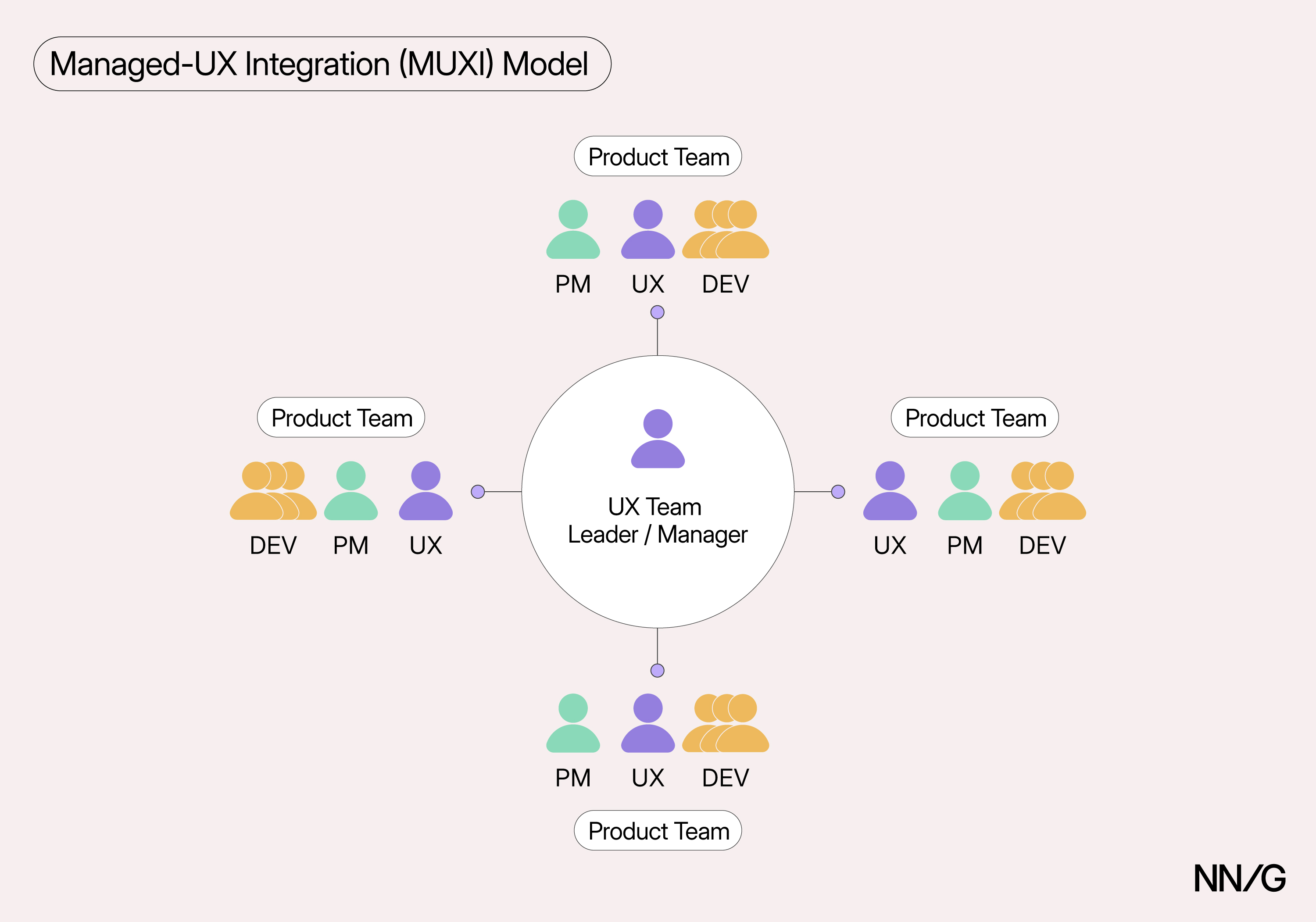
In the managed-UX integration model, UXers report to UX leadership, stay connected to their peers, and work daily with product teams to drive outcomes.
How Should UX Teams Be Structured?
As product development grows more complex, so do the questions related to team models and reporting structures:
- Should UX professionals report to product managers? (NO! UX is not the same as product management.)
- Should they stay centralized under UX leadership? (Maybe, but this often leads to an adversarial “UX-as-a-short-term-service” relationship between UX and product teams.)
- Or should they follow a matrix structure with two reporting lines, usually with one to UX and another to product management? (Enter competing priorities, communication overhead, and confusion about decision-making authority).
These complex questions are hard to answer and reflect a deeper issue: balancing UX expertise with close integration into product development.
The Managed-UX Integration Model (MUXI)
While many organizations try centralized, decentralized, or matrix team and reporting structures, there’s another approach to consider, which I call the managed-UX integration model (MUXI). In this model, UX professionals report to UX leaders but work daily with their product team for longer durations.
These dedicated UX leaders and managers handle performance reviews, skill development, training, and mentoring. At the same time, practitioners are fully integrated into a product-development team for longer durations, beyond isolated projects or initiatives. UX joins standups and planning sessions and collaborates daily with product managers and engineers.
MUXI avoids the pitfalls of both the matrix and the centralized model, including the confusing dual-reporting structures of matrix models and the centralized teams’ isolation and short-term involvement. It also addresses gaps in decentralized models, which often lack dedicated UX managers or a cohesive, internal UX community.
The MUXI model keeps UX cohesive while ensuring that designers and researchers shape product decisions.
What Makes the Managed-UX Integration Model Different?
The model combines the best aspects of the centralized and decentralized models without the downsides. It also supports UX growth and team camaraderie while integrating practitioners in product work. It doesn’t force a choice between team unity and embeddedness; it enables both.
While MUXI is closely related to a matrix structure, it removes any UX reporting and accountability to product management. In a matrix model, UX practitioners are often stuck in the middle, reporting both to a UX manager and directly or indirectly to product management. This dual accountability forces UX to constantly decide whose demands to serve, creating confusion, wasted effort, and structural disadvantage. In practice, product management usually wins: it decides when (or if) UX research happens, whether to spend budget on good design or “just make the screens.” UX is left reacting to those calls rather than shaping them.
In the MUXI model, UX reports only to UX leadership. Product managers still provide valuable input, but there is no accountability line from UX to product. Instead, any negotiations over priorities happen between UX leadership and product leadership, not at the practitioner level. This frees UX practitioners to focus on research and design, rather than navigating politics. The clarity of single accountability empowers UX to own its craft and creates a healthier balance, where business and experience priorities are decided on equal footing, and neither structurally overrides the other.
|
Matrix Model |
MUXI Model |
|
UX has dual accountability; reports to both UX leadership and product management. |
UX has single accountability; reports only to UX leadership. |
|
Creates confusion about priorities and wasted energy deciding which manager to serve. |
Removes the “two managers” problem; accountability is clear. |
|
Product management often decides when research or design effort is warranted. |
UX has an equal seat at the table in deciding when and how to invest in research and design. |
|
UX can become subordinate or adversarial to product. |
UX and product collaborate as peers with balanced influence. |
|
Practitioners are left to negotiate conflicting demands on their own. |
Burden shifts upward: UX managers and PM managers negotiate, leaving practitioners free to focus on design and research. |
Why Managed-UX Integration Works
By joining product teams early and staying on them for more than one project, UX practitioners can confidently shape direction and decisions alongside product management and engineering, rather than working in isolation, being brought in only when needed (as a “nice-to-have”) or, worse, after the fact.
UX stays aware of what’s happening within the product team to lead or assist with discovery, planning, and prioritization, rather than just polishing the interface at the end. Early and consistent involvement results in more user-centered products and fewer changes and conflicts later.
When UX is involved in daily product work, communication improves. UX teams better understand organizational goals and technical constraints, while product managers and engineers learn more about what UX does and why it matters. The more frequent collaboration also leads to a better shared understanding of users.
Common Pitfalls to Avoid with MUXI
UX Managers Are Too Far Removed
Because UX managers may lack visibility into their reports’ day-to-day work, reviews and interventions can be harder. This challenge exists in both matrix and MUXI models, but in the matrix model, product management fills the gap at the cost of UX autonomy. In MUXI, UX managers retain sole accountability, fostering a healthy work environment. However, this approach requires them to stay deliberately close.
Solution
UX managers should hold regular one-on-ones, lead weekly and valuable community-of-practice meetings, and periodically join critiques, research shares, or product reviews to stay connected to their practitioners’ work.
Accountability Gaps with Product Teams
Because UX practitioners report only to UX managers, product teams may feel they have little authority if UXers aren’t delivering what’s needed. In a matrix model, product management has more direct leverage, but in MUXI, that dynamic is intentionally removed. The risk is that product managers may see UX as “untouchable” or outside of their influence.
Solution
UX managers need to actively set expectations with product leaders: product and engineering managers should provide feedback on UX collaboration, responsiveness, and quality of deliverables. UX managers can then incorporate that feedback into one-on-one discussions, priorities, and performance reviews. This way, product and engineering partners still have a voice, without creating a hidden dotted-line reporting structure.
Practitioners Get Siloed
If UXers belong to two teams (UX and their product team), they may feel as if they are in neither. Others may see them as outsiders pushing a specific agenda.
Solution
Product managers and engineers (and all other product-development-team members, for that matter) should treat UX as full members of the product team. UX should be invited to retrospectives, critiques, workshops, and other team events and asked to weigh in on important decisions.
Resource Allocation Becomes Rigid
When UXers are assigned to a single product team, especially for an extended period, moving them to other product teams can become challenging if priorities shift.
Solution
Maintain a few flexible UX roles that can support multiple teams and review team allocations regularly. Crosstrain designers and researchers so they can flexibly step in when they’re needed elsewhere.
Adapting the Model by Organization Size
The managed-UX integration model can adapt to organizational size and context, while keeping one principle consistent: UX practitioners should always report through UX leadership, never to product management.
Startups
A single UX lead may support several product teams, while also establishing early UX practices. Even when stretched thin, that lead remains the sole reporting line for UX, giving the discipline a clear home base from the beginning.
Small Companies
With limited headcount, it’s not always possible to embed UX in every product team. Instead, leaders must prioritize where UX will have the greatest impact: on core products, high-growth areas, or complex user flows. Practitioners may “float” between teams, but they should remain anchored in UX through their manager and community of practice, to avoid drifting toward a decentralized model. Some experience design roles (e.g., accessibility experts, service designers, content strategists) naturally support multiple teams. In MUXI, these specialists are still managed by UX leadership and intentionally deployed where needed. They should not be pooled under product, in order to preserve UX consistency and autonomy while extending its reach.
Mid-Sized Organizations
Mid-sized companies should embed UXers in each main product area, with a UX director overseeing multiple UX managers with UX direct reports. At this scale, it’s important to clearly define and formalize how UX and product collaborate. Outline how UX and product prioritize work, how much time UX spends with product teams versus on community work, and how practitioners contribute to shared tools like design systems, research operations, and team charters.
Enterprises
Larger organizations add more layers: a VP of UX may oversee several UX directors and managers with direct reports, while embedded designers work in product teams’ day to day. Specialists like quantitative researchers or content strategists remain centralized under UX leadership but support multiple teams. Design systems, governance groups, and cross-team rituals align the larger community of practice to maintain quality across the enterprise.
Making MUXI Work
To shift to the managed-UX integration model, don’t start with the structure; begin with a purpose.
- Identify the pain points in your team model or reporting structure.
- Build a clear case for change and a plan for evaluating success.
- Involve leaders from UX, product, and engineering.
No team model is perfect; each comes with tradeoffs. The centralized model can feel disconnected, while matrix reporting creates confusion and wasted effort. The decentralized model poses fragmentation risks and limits professional growth for UX professionals.
The managed-UX integration model offers a pragmatic alternative. By keeping reporting lines firmly within UX while embedding practitioners in product teams, MUXI preserves autonomy, strengthens community, and enables daily collaboration where decisions are made. It reduces the structural disadvantages that come from dual accountability, while still ensuring UX has a strong voice in shaping products from discovery through delivery.
Like any structure, MUXI requires care: managers must stay close to their practitioners, product partners must have a voice without controlling UX, and organizations must remain flexible as priorities shift. When practiced intentionally, the model creates the conditions for UX to thrive, not as a service or a subordinate, but as a peer working alongside product and engineering to deliver better outcomes for users and the organization.