Summary:
RAS helps managers allocate resources based on actual impact, shifting focus from outputs to outcomes and enabling data-driven UX strategies.
In articles 1 and 2 of this series, we defined research breakage, introduced the recommendation-adoption score (RAS) (see the template here), and showed how to calculate it. In this article, we turn to how leaders should use that data.
Most research leaders make research-investment decisions based on intuition, in response to squeaky wheels, or simply by allocating resources to those who happen to ask. But do these choices maximize the impact of the research team? This is where RAS comes in. Beyond exposing breakage, the RAS helps managers allocate their research talent and resources to where it matters most and provides them with clear justification for these decisions.
A Reminder of What RAS Measures
RAS captures the proportion of recommendation value that actually reaches users. Adopted recommendations count as full value delivered to users. Committed recommendations count for partial progress. All other communicated recommendations that have not been implemented, or at least committed to, sit in the denominator as potential value that has not been realized yet.
Recommendations are also weighted. High-value fixes earn 3 points because they directly affect users and are tied to task success, retention, or satisfaction. Medium-value fixes earn 2 points. They matter, but their impact may be less visible day-to-day. Low-value fixes, however, address rough edges. They will rarely be noticed by themselves and so they earn only 1 point. Committed recommendations — those scoped, resourced, and scheduled but not fully implemented — count for partial progress at 0.66 points each.
The calculation is simple. A score of 0 means nothing has moved. A score of 100 means every recommendation has been committed or adopted. Scores between those extremes reveal how an organization really reacts to research.
Why Managers Need More than Outputs
The number of studies completed, reports delivered, or insights logged can make a team look busy. But busy is not the same as impactful. RAS forces the conversation to shift from outputs to outcomes.
It is easy for managers to hide behind activity metrics because they look neat on a dashboard. But a long list of completed studies does not tell you if a single user’s experience improved. Imagine one product team that receives 10 reports in a quarter but ignores them all, and another that receives 3 reports but acts on every high-value fix. Without RAS, the first team appears busier. With RAS, you can see which team is actually making an impact on the user experience.
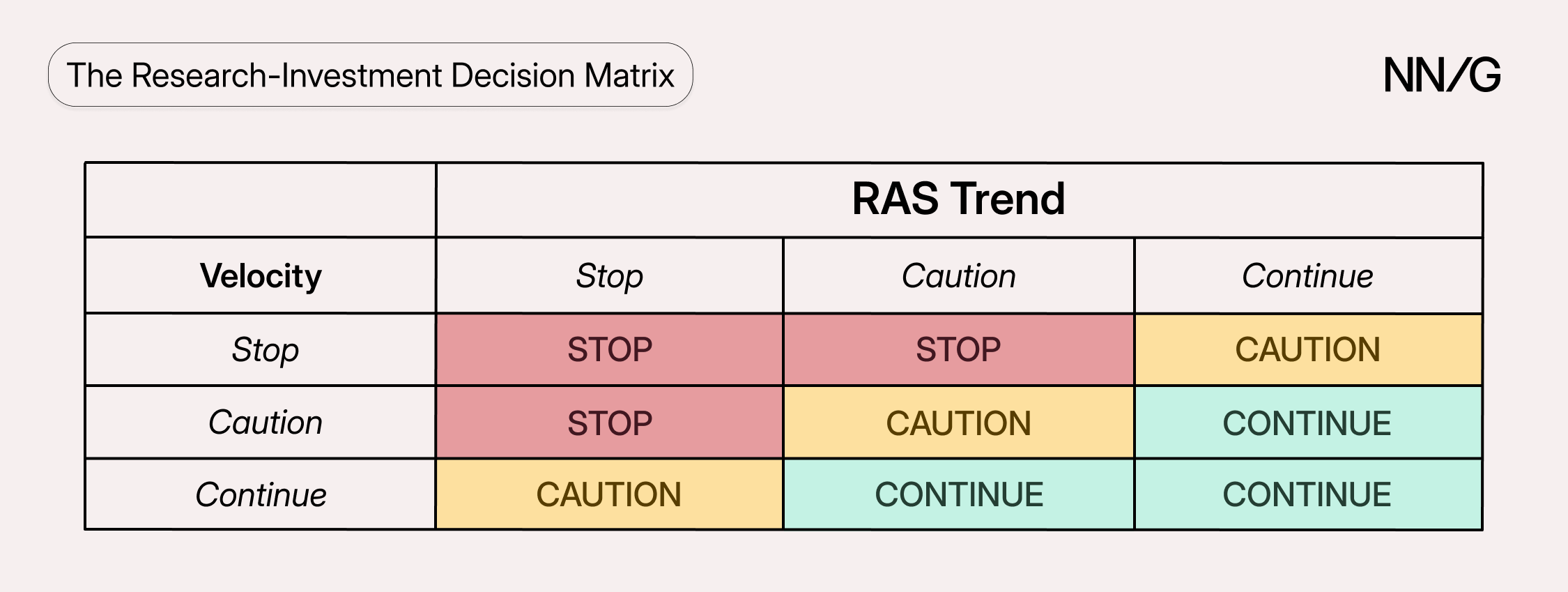
The Research-Investment Decision Matrix: Pairing Velocity with RAS
RAS tells you whether recommendations are being adopted. That is useful, but it is only one side of the coin. You also need to know whether recommendations are still being produced. Otherwise, you might overcommit resources to a team that is no longer generating new work.
To decide whether research investment in a team produces value and should be continued, we propose a 2-component framework, taking into account both the research-recommendation output and the recommendation adoption (RAS). Each of these contributes to the overall research-investment signal.
Recommendation-Velocity Signal
Velocity is about research-recommendation output. Specifically, velocity is the average number of recommendations created per month in the last three months.
The recommendation velocity can guide research-investment decisions. These thresholds below provide a baseline for managers to determine if a product team is actively engaging with research and the efforts should continue, or if the partnership has stalled and should be stopped. We landed on these after tracking research velocity at Cisco across multiple product teams over two years. We offer them as a tested starting point, not a mandate –- they should be calibrated to your organization.
|
Recommendation velocity (3-month average) |
Signal |
|
|---|---|---|
|
0–1 recommendations/month |
STOP |
Research is barely happening or has slowed down to the point where it cannot justify sustained support. |
|
2–3 recommendations/month |
CAUTION |
There is research output, but not enough to guarantee momentum. This could mean the product is stabilizing or it could mean research is being sidelined. |
|
3+ recommendations/month |
CONTINUE |
Research is producing consistently. There is purpose to the research involvement. |
In practice, these thresholds should be adjusted so that the ranges reflect your reality. A team producing enterprise-level studies might have lower velocity but higher impact. A consumer product might generate dozens of smaller recommendations. The goal is to set thresholds that drive teams to act on recommendations.
One additional note on velocity: not every recommendation carries equal weight. A team generating two careful, high-value recommendations a month may be doing more good than a team producing a dozen cosmetic ones. The thresholds help set a baseline, but context always matters. The matrix is a starting point for a conversation, not a trigger for an automatic decision. Managers should ask not just how many recommendations are being produced, but what kind.
RAS Trend Signal
Velocity alone is not enough. You also need to know how adoption is changing over time. The RAS trend captures the slope of the six-month RAS rolling average; together with the actual average RAS (over the past 6 months), it gives us another data point for deciding further research investment.
|
RAS |
RAS trend |
Signal |
|
|---|---|---|---|
|
Poor to Fair |
Negative |
STOP |
Research implementation is low and not improving. It is a signal to stop investment |
|
Good |
Neutral or Negative |
CAUTION |
If the RAS is good, but the trend is negative, proceed with caution. If the RAS is already at a strong baseline, then a flat trend can be tolerated. Slipping momentum, however, is a red flag. |
|
Fair to Good |
Positive |
CONTINUE |
Any positive trend, regardless of baseline, is a signal to continue investment. It shows things are moving in the right direction. |
This is where inexperienced leaders sometimes get tripped up. A team with a strong baseline score that flattens for a few months is not necessarily failing, because adoption takes time. What matters is whether the slope stays positive over quarters, not weeks. A short-term dip after a large batch of recommendations is normal. What is not normal is when the line never recovers.
The Investment Signal: Combine Velocity with the RAS Trend
Equal RAS scores do not mean equal situations. By combining velocity and the RAS-trend signals, you get an overall investment signal that can guide your resourcing decision. There are 3 possible values for the overall investment signal:
- STOP: Pull the research resources. Either the team is not generating recommendations, or they are not acting on them. Continued research support here is wasted.
- CAUTION: Keep light engagement, monitor closely, or assign a persuasive communicator who can turn things around.
- CONTINUE: Double down. Research is being created and adopted. This is where your team has leverage and can have the greatest impact.
The decision matrix gives you a defensible way to explain research-resourcing decisions to both executives and your own researchers.
To see how it works in practice, consider these 5 example products; running each through the matrix produces a clear investment signal.
|
Product |
RAS |
Velocity (per month) |
RAS Trend |
Component Investment Signals |
Overall Investment Signal |
Interpretation |
|
A |
6 |
0 |
Negative |
Velocity: STOP RAS trend: STOP |
STOP: pull the resources |
Declining RAS trend and no velocity |
|
B |
37 |
3 |
Positive |
Velocity: CAUTION RAS trend: CONTINUE |
CONTINUE –- keep engagement and monitor. |
Mediocre velocity but a positive trend |
|
C |
39 |
1 |
Negative |
Velocity: STOP RAS trend: STOP |
STOP: pull the resources |
Downward RAS trend and no velocity |
|
D |
67 |
4 |
Neutral |
Velocity: CONTINUE RAS trend: CAUTION |
CONTINUE: stay invested but watch whether momentum builds |
Solid velocity but a flat trend |
|
E |
92 |
5 |
Positive |
Velocity: CONTINUE RAS trend: CONTINUE |
CONTINUE: double down and keep investing the team here |
Strong velocity and a rising RAS |
It is worth comparing Products B and C. These products have nearly identical RAS scores in the Fair range. Product B has steady velocity and an upward RAS trend, whereas Product C has almost no velocity and a downward RAS trend. On paper the RAS for these products looks the same, but the decisions are different: B earns continued support, but C should be stopped. The difference in these decisions came from pairing velocity with adoption.
Resource Allocation and UX-Career Growth
RAS also helps match researcher strengths to the maturity of each product area.
Let’s reconsider four of the products presented above.
|
Product |
RAS |
Velocity (per month) |
RAS Trend |
Interpretation |
|
A |
6 |
0 |
Negative |
Stop. This team ignores research entirely. Do not waste resources. |
|
B |
37 |
3 |
Positive |
Fair adoption, with some signs of traction. Assign a researcher who is strong at influence and persuasion. |
|
D |
67 |
4 |
Neutral |
A healthy partnership. This is a safe assignment for early-career or mid-level researchers. |
|
E |
92 |
5 |
Positive |
This is a model team. Use it as a mentoring ground, a place to test new methods, or to reward senior researchers who want a high-impact environment. |
Putting an early-career researcher on a low-adoption product is not a development opportunity. It is a setup for burnout that leadership will eventually misread as a performance problem. Matching researcher profile to team maturity is how you prevent that, and how you protect research credibility at the same time.
Coaching and Conversations
Resource allocation does not end with staffing decisions. Once researchers are placed, RAS gives managers a lens for ongoing coaching that keeps those placements working. In one-on-one meetings, the score points toward different actions depending on what it reveals:
- Low RAS plus strong research? That points to a stakeholder issue, not a researcher issue. The fix is escalation or reassignment, not coaching.
- Low RAS plus vague recommendations? That is a coaching moment. Help the researcher frame findings more clearly so adoption improves.
- High RAS plus low-value work? Push for deeper, riskier studies. The team is ready for it.
Instead of asking “why are you failing,” a manager can ask “why is this score low?” That shift keeps the conversation focused on the system, not the person, which is exactly the mindset that makes resource decisions defensible. Sometimes the answer leads to better research recommendations. Sometimes it points to a need for stronger executive support. Either way, RAS makes the conversation specific rather than vague, and actionable rather than personal.
The point is not to judge but to calibrate. Coaching conversations informed by RAS feed directly back into allocation decisions: they surface whether a placement is working, whether a researcher needs support to succeed, or whether the real problem is upstream.
Where We Go Next
RAS tells you what is happening inside a product team. But some adoption problems are not team-level problems. They are organizational. In our next article, we look at what happens when the bottleneck is not a product manager ignoring research but an executive culture that never prioritized it in the first place, and what RAS reveals about that.
Key Takeaways
- Use RAS to measure actual recommendation adoption rather than just research activity, ensuring the focus remains on achieving meaningful user-experience improvements.
- Research velocity measures the average number of recommendations created per month over the last three months. The RAS trend tracks the slope of a six-month RAS rolling average to determine whether adoption is improving, flat, or declining.
- Combining RAS trend with velocity establishes a defensible stop-caution- continue framework for resource allocation and staffing decisions.
- Matching researcher seniority and skill sets to the maturity of the product team prevents burnout and supports objective coaching conversations and career advocacy.