Summary:
Use this maturity model to assess your design system’s health and identify where to focus next.
Design-system maturity frameworks often follow a linear progression: you start by building components, move to driving adoption, hit the growing pains of scale, and eventually reach a steady state of governance and evolution.
But design systems don’t mature in a straight line — the reality of design-system work is much messier and more multifaceted than a ladder can capture. This article proposes an alternative that treats design-system maturity as a multidimensional assessment rather than a sequential journey.
Where Linear Models Fall Short
While sequential maturity stages help visualize how systems evolve over time and establish broad milestones that organizations can use to benchmark progress, the linear model flattens the reality of design-system work.
Maturity isn’t always forward progress. Linear maturity models typically frame growth as a steady climb toward an ideal end state. In reality, many design systems regress in ways out of their builders’ control: organizations restructure, business priorities shift, budgets get cut, and so on. A mature, well-adopted enterprise design system may suddenly face foundational challenges again after a merger introduces a second system with incompatible tools, tokens, or workflows. Linear models leave little room for regression, stagnation, or scenarios where a system is deliberately kept lean because it aligns with the organization’s scale.
There is no universal narrative of system growth. A 10-person startup and a 10,000-person enterprise can both have a mature design system, but the conditions that define maturity can differ significantly. Linear models often assume a single destination for maturity, when, in reality, maturity is contextual to organizational scale, structure, and culture.
Adoption is never complete. Linear models typically place adoption after the initial build. In practice, driving adoption is an ongoing concern. Teams at every stage wrestle with it: early teams convincing their first subscribers, maturing teams maintaining trust during major version changes, established teams fighting adoption erosion when priorities shift. Adoption is an ongoing organizational challenge that persists throughout the system’s lifecycle.
The 6 Core Dimensions
Design-system practice is multifaceted. Ask five practitioners to define what a design system is, and you’ll get five different answers because design-system work spans design, development, strategy, operations, governance, and organizational politics all at once. When we spoke to teams across organizations, that breadth was reflected in how their systems matured differently: not along a single axis, but across several dimensions at once, and almost never evenly.
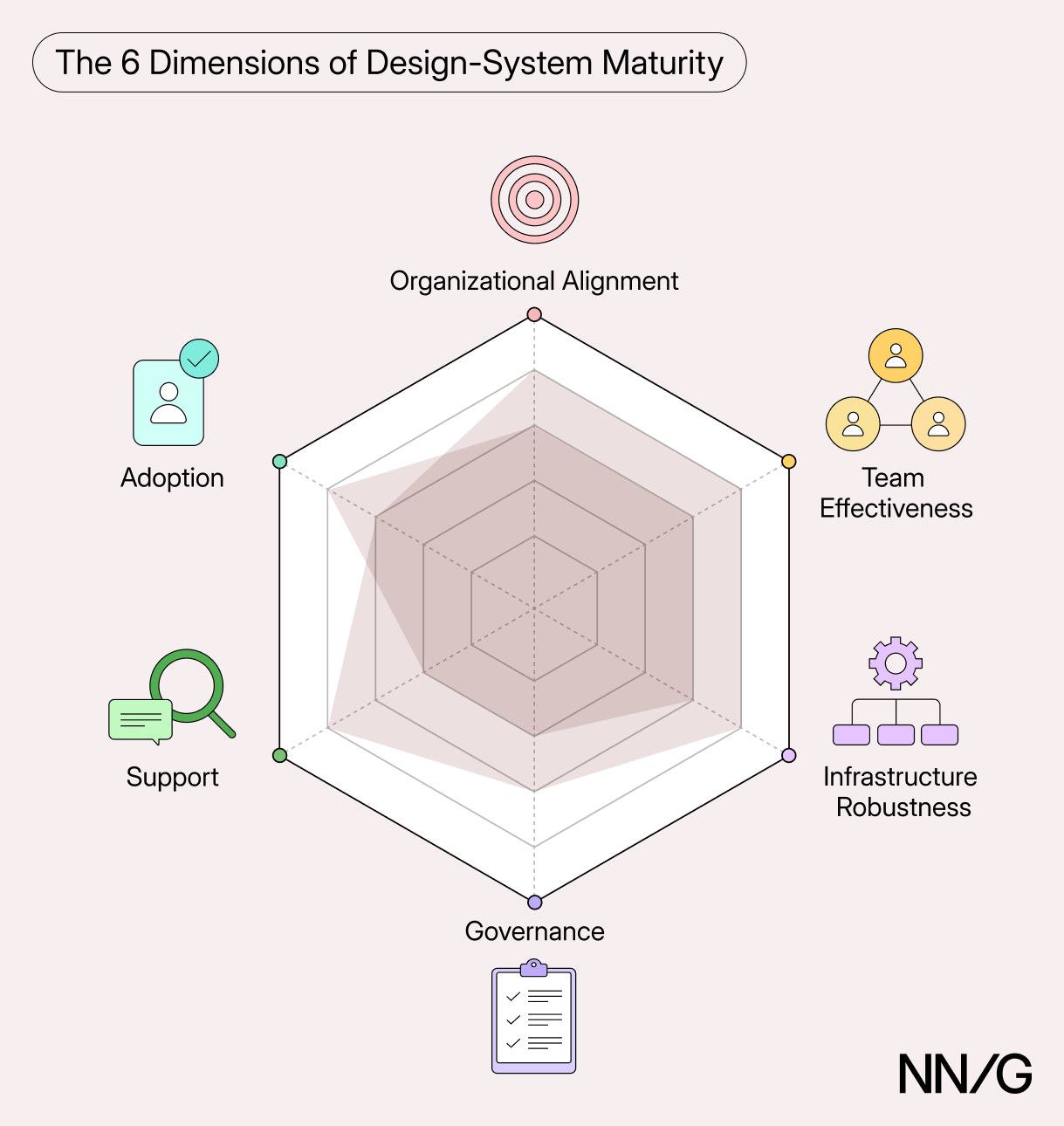
Through our research, we identified 6 core design-system-maturity dimensions that reflect the holistic view of the design-system practice:
- Organizational alignment: How well the design system is positioned, funded, and championed within the broader organization
- Team effectiveness: Whether the design-system team has the capacity, composition, leadership, and collaborative practices to sustain the system long-term
- Infrastructure robustness: The quality and completeness of the system’s deliverables, including components, tokens, documentation, tooling, and underlying visual and technical foundations
- Governance: The operating model for making decisions, managing contributions, and maintaining coherence as the system and organization evolve
- Support: The active investment the design-system team makes in equipping design-system users to find, understand, and succeed with the system
- Adoption: How broadly and deeply teams across the organization actually use, trust, and rely on the design system
Plot where your design system lies on each of these dimensions, and the resulting shape becomes the system’s profile — a snapshot of the design system’s health at a given point in time. Dimensions are independent of each other. The design system’s profile provides diagnostic insight into its maturity, and signals opportunities for improvement: imbalances, dependencies, and trade-offs.
1. Organizational Alignment
Of everything that determines whether a design system endures, organizational support may be the most foundational. A system may survive incomplete documentation or loosely defined governance for a while, but it cannot survive an organization that has decided it isn’t worth the investment.
This dimension includes:
- Leadership sponsorship: Is there an executive sponsor who advocates for the system and protects its priorities?
- Funding stability: Is the system resourced through a dedicated, predictable budget, or does it survive on borrowed time and goodwill?
- Strategic positioning: Is the system understood as a core product or shared infrastructure, or as an optional service that teams can take or leave?
- Crossfunctional buy-in: Is the design system backed across product, engineering, brand, and other partner teams?
These factors determine whether a system can hold its ground through leadership turnover, reorganizations, and shifting budget priorities.
2. Team Effectiveness
Whether a design system can sustain and scale over time depends heavily on the effectiveness of the team behind it. Even a strong design system will falter if the team behind it lacks the appropriate mix of skills, adequate resourcing, or clear decision-making structures.
Team effectiveness covers:
- Capacity and sustainability: Is the team appropriately sized and operating at a sustainable pace?
- Crossfunctional expertise: Does the team include or have access to design, engineering, content, accessibility, and product management?
- Collaboration and team dynamics: Does the team have strong design–engineering partnerships and effective ways of working together? Is there sufficient trust and psychological safety to raise concerns and challenge decisions?
- Staff wellbeing: Are team members motivated, supported, and able to do their best work over time?
A team strong on these fronts can carry out the work reliably, stay coordinated under pressure, and adapt as the system evolves.
3. Infrastructure Robustness
This dimension is about the artifact itself: what the design-system team builds, ships, and maintains. It is often the most visible dimension of a design system, as it corresponds directly to the artifacts teams interact with day to day.
Infrastructure robustness evaluates:
- Component coverage, consistency across platforms, and parity between design and code implementations
- The structure and scalability of foundations and design tokens
- The completeness, clarity, and usability of documentation
- Tooling quality and overall developer experience
- Content standards and baked-in accessibility practices
Together, these elements form the scaffolding of digital products: they shape interface behavior, reinforce brand expression, and directly impact user-experience quality.
4. Governance
A design-system team needs a well-defined operating model to sustain its practice and standards: Who decides if a component gets added? Who reviews a breaking change before it ships? What happens when a product team needs something the system doesn’t have yet? Governance answers these questions. It lays out who does what, when, and how. Without the structure, a shared system can quickly become everyone’s concern but no one’s responsibility.
A design system’s governance practice encompasses the structures, policies, and workflows that shape how the system operates and evolves. This includes:
- Contribution models: How do product teams contribute to the system, and what structure guides that participation?
- Deviation management and decision making: How are exceptions handled when a team needs something the system doesn’t offer? Who decides what enters the system, and how are conflicts resolved?
- Flexibility philosophy: How does the system balance product expression against brand consistency?
- Versioning and release strategy: How are changes versioned, communicated, and shipped without disrupting the teams that depend on them?
- Prioritization frameworks: How does the team decide what to build, fix, or improve next?
5. Support
A well-architected system doesn’t guarantee that teams can use it. A component can exist in the library and still be practically invisible to product designers who are unaware of it, cannot find it, or are unsure how to apply it. This dimension evaluates the active effort directed at making the system discoverable, understandable, and usable in real product work.
Support includes all the following aspects:
- Onboarding and learning support (getting started, education, training)
- Responsive support (help channels, office hours)
- Communication and visibility (changelogs, roadmap, release notes)
- Advocacy and champions programs, as well as the feedback loops that keep the team connected to the real needs of system users.
6. Adoption
While adoption is one of the most common measures of a design system’s success, usage alone doesn’t reveal whether teams trust it, use it well, or quietly work around it. This dimension examines how widely the system is used, how effectively it is applied in product work, and how deeply teams trust and depend on it.
Adoption measures a few distinct layers that are often conflated:
- Usage: Do teams have access to the system, and are they actively using it?
- Conformance: Are teams applying the system correctly and consistently, rather than creating unintended variations or bypassing established patterns?
- Trust: Do teams view the system as reliable, well-maintained, and capable of evolving to meet their needs?
Assess Your Design-System Practice
Conduct a design-system maturity assessment to understand how your design system is doing. The assessment works best as a team exercise, as different roles will bring different perspectives to the system.
Step 1: Choose Your Evaluators
Aim for 4–8 evaluators representing different vantage points:
- Design-system team members across disciplines (design, engineering, product, content)
- Product-team representatives who use the system day-to-day
- Key stakeholders or sponsors who can share perspectives on the system’s organizational alignment
For larger design-system teams, include more evaluators to capture a wider range of perspectives. Aim for enough diversity to surface meaningful disagreements, but not so many voices that alignment becomes difficult to reach.
Step 2: Score Independently
Each evaluator scores the design system on all six dimensions, using a 1–5 scale.
|
Score |
Level |
What It Means |
|---|---|---|
|
1 |
Absent |
No intentional structure or ownership is in place. Efforts are ad hoc, if they occur at all, and largely depend on individual initiative. |
|
2 |
Emerging |
Some awareness or early effort exists, but practices are inconsistent, informal, or difficult to sustain. |
|
3 |
Functional |
A defined approach supports routine needs, but the system remains fragile under change, scale, or increased complexity. |
|
4 |
Strong |
Practices are consistent, clearly owned, and reliably applied. Outcomes hold steady across most operating conditions. |
|
5 |
Exceptional |
The approach is mature, continuously improving based on measured outcomes, and resilient through major organizational changes. |
Step 3: Triangulate and Align
Once all evaluators have completed their assessment, bring the group together to discuss.
Start with alignment. Dimensions with narrow score ranges reflect a shared understanding. Note the consensus and move on.
Next, focus on areas of divergence. For dimensions with a larger range of scores, use the gap as a prompt for discussion.
For example, if a product-team member rates support as a 2 while the design-system team rates it as a 4, the gap may indicate a mismatch between intended investment and perceived impact. It could suggest that product teams are not fully aware of available resources and need better onboarding, or that the design-system team does not effectively communicate or distribute its offerings. These conversations help surface actionable opportunities to improve how the system is supported and understood.
Step 4: Plot the Shape
After aligning the scores with your team, plot them on a hexagonal radar chart and connect the points to form the team’s profile.
Read the shape and look for the following patterns.
Shape Area
The overall area of the shape indicates general maturity, but it should not be interpreted in isolation. Align your expectation to organizational reality: A smaller area is not always problematic — it may simply reflect organizational scale or stage. Young design systems often show lower scores across dimensions compared to mature organizations with established systems and operating models.
Shape Symmetry
Symmetry reflects whether capabilities are developing evenly. A smaller, balanced shape is often more stable than a larger, uneven one. For example, a system that scores 5 on support but only 2 on team effectiveness is unlikely to sustain performance as the expected level of service exceeds what the team structure can reliably deliver.
Valleys
A low score on one dimension compared to all the others often indicates structural constraints. Even when other areas score highly, a single weak dimension can undermine the system’s overall effectiveness. Prioritize improving the lowest point first; addressing the bottleneck can relieve pressure on other dimensions.
Spikes
High outliers may signal uneven investment across the system. The key question is whether they reflect intentional strategic emphasis or compensation for underlying gaps.
A spike in infrastructure robustness, for example, may indicate a team has invested heavily in assets — the tangible work they’re most comfortable building — while the capabilities needed to operationalize those assets, such as governance and support, lag behind. A high score in organizational alignment, paired with low scores elsewhere, could indicate strong executive intent that has not yet translated into operational capacity.
Tension Between Strengths and Weaknesses
Look at how high and low scores on the 6 dimensions interact. Are strong areas compensating for weak ones? Is effort concentrated in areas that don’t resolve the system’s bottlenecks? Identify the single weakest dimension that, if improved, would most effectively unlock the value of existing strengths.
Step 5: Benchmark and Reassess Regularly
A maturity profile is a snapshot, not a permanent diagnosis.
Reassess and report out on a regular cadence — typically quarterly, or following meaningful organizational shifts such as a reorganization, major release, or budget change. These moments often reshape how the system operates and are natural inflection points for recalibration and learning.
Maintain the baseline as a point of reference and compare each new assessment against it over time. This longitudinal view helps reveal whether the system is strengthening, fragmenting, or adapting to new constraints.
Alignment Over Assessment
Beyond the scores themselves, one of the biggest advantages of conducting the assessment is creating the time and space for the team to align. In many cases, this shared discussion is more impactful than the scores produced.
When you involve team members, design-system users, and sponsors in the assessment process, you signal that their perspectives meaningfully shape direction. This shared participation builds ownership. It also leverages the IKEA effect: once people contribute to defining the system’s strengths and gaps, they are more likely to feel invested in its success and more inclined to adopt and support it in practice.
Summary
Managing a design system is an ongoing practice that evolves alongside the teams, products, and priorities it supports. Components may be the most visible artifact of a system, but they are rarely what determines whether the system succeeds or fails.
What matters just as much is whether teams trust it enough to rely on it, whether governance holds steady through change, whether organizational support persists when competing priorities emerge, and whether the people behind the system are resourced to sustain and evolve the work.
Viewed through this lens, design-system maturity is not a fixed state or a single metric to optimize, but a dynamic balance of multiple dimensions. A healthy system is not simply one that grows larger or older, but one that can remain coherent, resilient, and useful as the organization evolves.