
Summary:
Even if AI matches researcher-output quality, human-led research will remain essential — the team learning from observing users can’t be outsourced.
Some people argue that AI can eliminate the need for research. Why speak to real people — who are hard to pin down — when AI can simulate them or interview them for you? Why analyze your data when AI can sort and theme it in seconds?
Today’s AI can’t moderate a session as well as an experienced researcher, and its analysis tends to be coherent but superficial. But those limitations may not last. Imagine AI becomes capable of designing, conducting, and analyzing studies well enough that the outputs are indistinguishable from those of an experienced researcher. Would that be the end of human-led research?
Research Produces More than Findings
Ten years ago, while researching adults who couldn’t read or write, I heard a participant describe how his reading difficulties went unnoticed as a child, leaving him embarrassed and isolated for decades. Growing up, he had watched his mother lose herself in a book and thought it looked so peaceful; he wished he could have that for himself. Eventually, a charity paired him with a volunteer who helped him learn, and he finally experienced the joy of reading for himself. When I later told my husband the story, it moved us both enough to donate to that same charity — an example of how research can change people in ways a report alone cannot.
Research produces two things. The first is outputs: the themes, the recommendations, the report. The second is harder to see but just as valuable: the learning that happens to the people doing the research — the observing, the wondering, the working through what the data means.
AI is good at producing the first. It cannot produce the second, because the second isn’t a deliverable. It’s an experience. A team that outsources research to AI gets a report, but it doesn’t get the learning. So even in a world where AI’s outputs are indistinguishable from an expert’s, something essential still goes missing.
Here’s why the second kind of value matters so much. Research is not just the collection of information — it is the transmission of human experience into design decisions. And stories are how that transmission often happens. When we interview a user, we ask them to tell us stories about their experiences. When we observe a user in a usability test, we tell a story afterward: what the user was trying to do, what happened, and how they reacted. When we argue for a content change or a new navigation, we tell the story of the research that led us there. When teams discuss what to design, they recount what users said or did.
Here’s the problem, though: if AI collects and analyzes data on our behalf, we miss out on experiencing the story. And that results in research not being as memorable or impactful as it should be.
You might be wondering: can’t AI tell stories as people do? Let’s set aside current limitations of synthetic users: their stories are often overly coherent, emotionally flat, and difficult to connect with in the way real human experiences are. However, even if AI users could tell powerful stories, there’s something special about being there — in the moment and witnessing the story for oneself.
A senior researcher I interviewed explained why she believes AI interviewers cannot fully replace human-led sessions: they remove the ability for a team to watch user research live and be moved by the same stories.
“We were all there. We all saw it. We all heard it. We all lived it. And those moments were always the fodder for pushing our design forward and inspiring whatever we ended up designing.”
Stories Have a Special Power Over the Brain
There’s abundant scientific evidence that stories have a special kind of power over our brains. Neuroscientists have used neuroimaging techniques, such as functional magnetic resonance imaging (fMRI), to study what happens when people listen to stories. And the research suggests that stories matter for at least three reasons (that are especially relevant to user research):
- They deeply engage people’s attention and memory.
- They help groups form shared understanding.
- They motivate action.
Stories capture our attention, a limited resource, and engage more of the brain. In one study, researchers from Michigan State University and UC Santa Barbara had people listen to three types of audio recordings: authentic personal stories, excerpts from a technical manual, and unintelligible reversed speech. They found that unintelligible speech stimulated the auditory parts of the brain. The technical manual went further and engaged regions responsible for language comprehension. But personal narratives triggered a widespread network of activity across listeners, including regions involved in social reasoning, emotional processing, and memory.
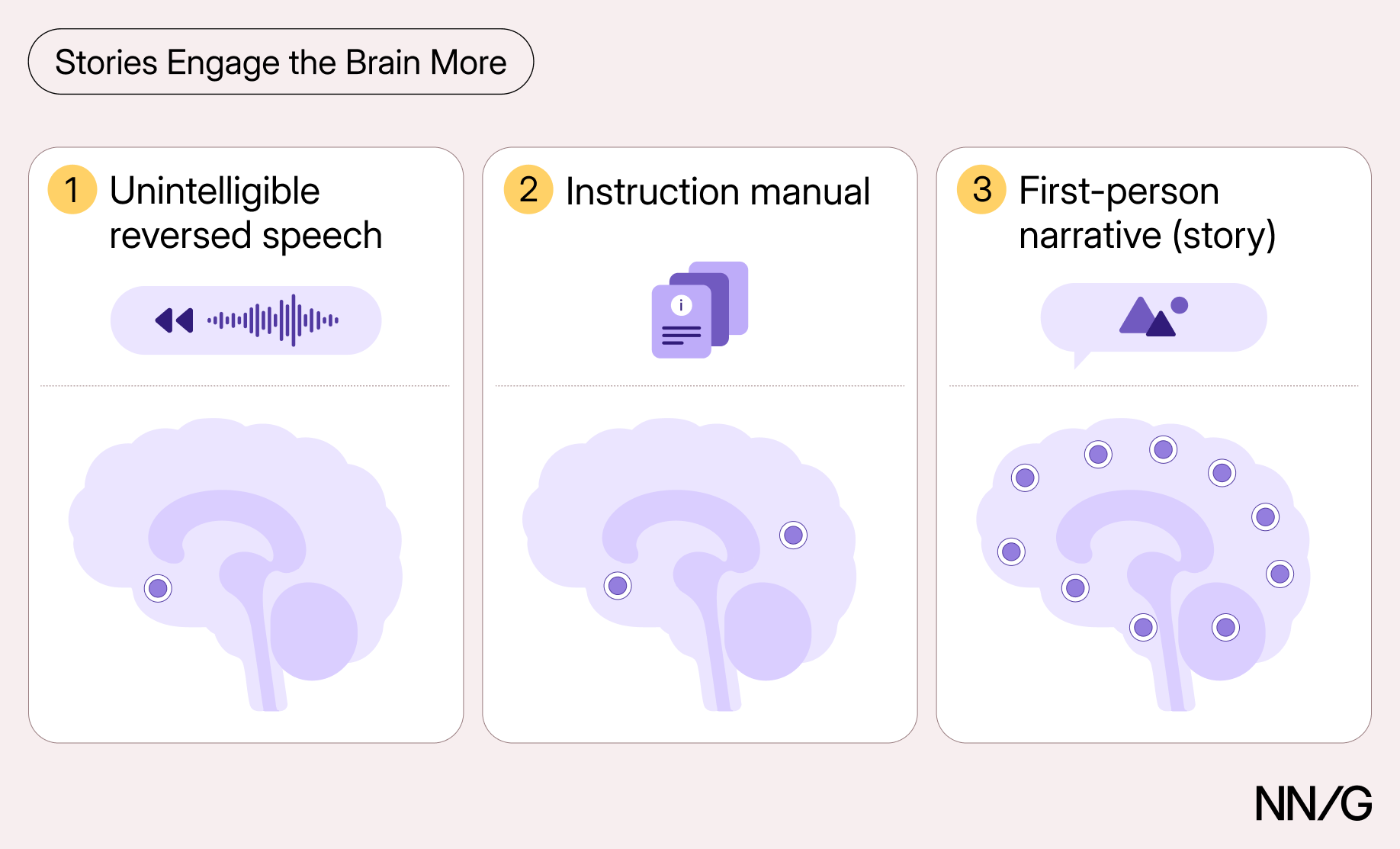
Not only that, but participants rated personal narratives as significantly more important than other samples.
In another study, researchers at Princeton University recorded a woman’s brain activity while she told a personal story, then recorded the brain activity of 11 participants as they listened to her tell it. They found that when people listen to a story, their brain activity begins to mirror the storyteller’s activity with a slight delay. Interestingly, the greater the mirroring, the better the listener’s comprehension and recall.
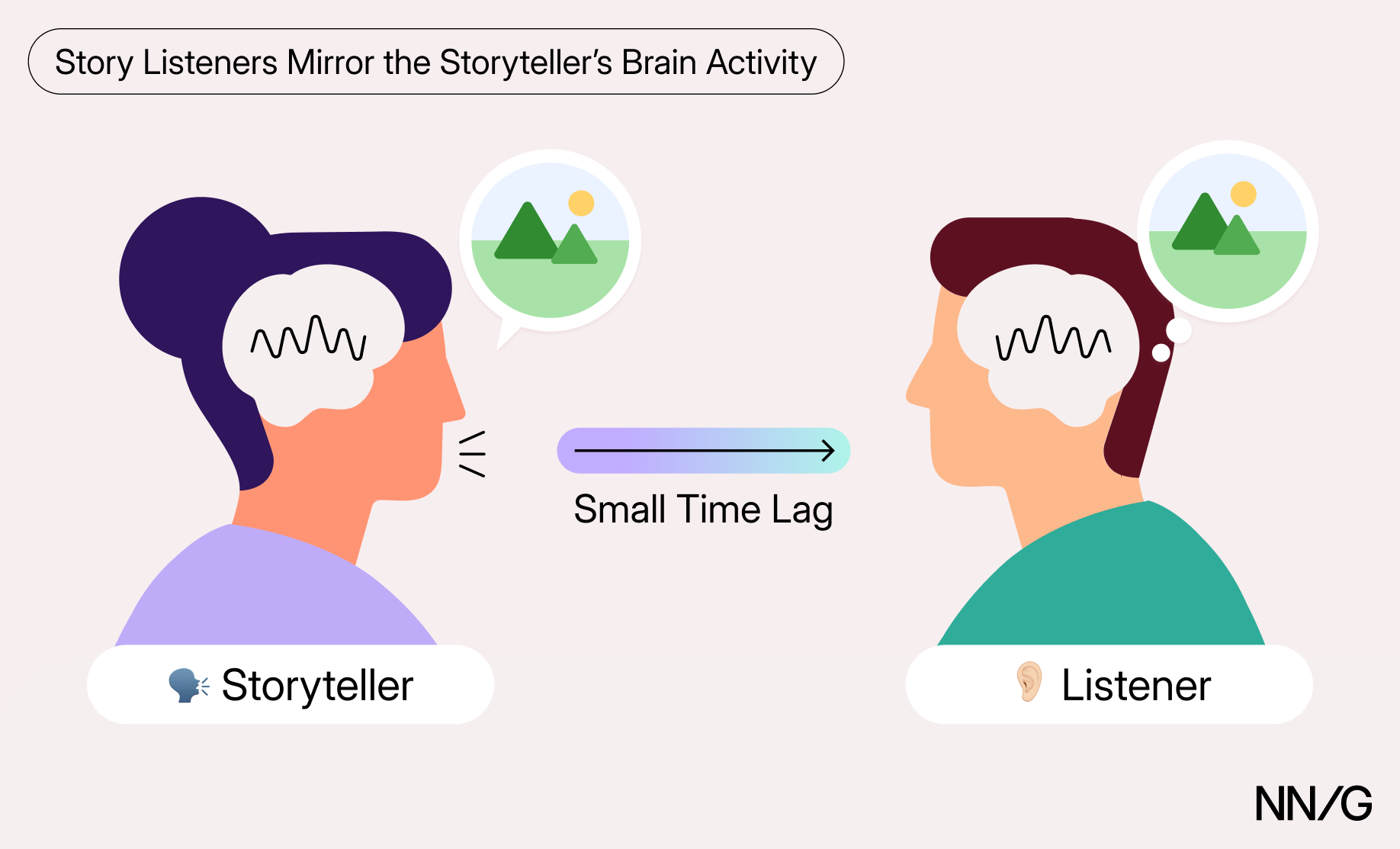
They also found that in higher-level brain regions, listeners’ activity even preceded the speaker’s activity — suggesting they were anticipating what would come next. The more successfully they anticipated it, the better they understood the story.
Stories don’t just help us remember or comprehend; they also drive empathy and, in turn, action. Paul Zak and his lab found that when people listen to a story that follows a dramatic arc — rising tension, falling tension, resolution — their brains release oxytocin. When participants experienced elevated oxytocin after hearing a story, they were more likely to donate to a related charity (which explains why my husband and I donated to the adult-literacy charity).
User Research Is a Team Sport
You may have heard the expression “User research is a team sport.” This mantra, introduced by the UK Government (where I started my UX career), was often repeated by leadership and solidified in posters tacked to most office walls, reminding us all that the value of user research lies in the active learning the team does together.
When teams participate in research together, they are moved by the same stories, develop a shared understanding of users and the problem space, and engage more deeply with the evidence itself.
Sadly, in many organizations, research gradually became something done by specialists and delivered as reports, rather than a collaborative learning activity. Once research is reduced to insight delivery, it becomes easier to imagine replacing parts of that process with AI. If the organization sees research primarily as a mechanism for producing findings, then faster automated findings naturally become attractive.
However, if you want your team and organization to understand, remember, and be motivated to use user insights, they must be actively engaged in research, speaking, and learning directly from their customers and users. The act is often as valuable as the output.
Learning Requires Effort, Not Just Exposure
You may have heard of the saying, “It’s not the destination, it’s the journey.” When it comes to learning, this is certainly very true. The process of conducting and analyzing research often creates more lasting understanding than the final output itself, because the work involved in deriving insights is what makes them memorable. This is known as the self-generation effect.
The self-generation effect is a phenomenon in which information generated is retained better than information merely read.
Teachers know this. That’s why students are encouraged to take their own notes or write and explain things in their own words. Researchers have found that students who use self-generation techniques consistently outperform students who don’t.
When you engage in research — whether it’s thinking about the questions you might ask in an interview, wondering over a participant’s response, thinking about how to code data, or doing the hard thinking to understand what’s relevant and what the data mean — you apply the self-generation effect. When you pass that work to AI, you get a report, but you don’t get the learning.
To make things worse, you might not realize how little you’re learning from reading a report. Reading a comprehensive, coherent report can create an “illusion of learning,” where you feel informed but retain very little afterward. For example, students who study for an examination by simply rereading study notes often report feeling prepared. However, their perception of preparedness doesn’t correlate with their actual performance in long-term-memory tests.
When AI handles the interviewing, analysis, and synthesis, it removes the wrestle. What’s left is consumption. The team reads the report, feels informed, and moves on. They’ve had the same comprehension experience as the students rereading their notes — and they’ll retain about as much.
Where AI Fits
None of this is an argument against using AI in research. Used well, AI can take over parts of the process that produce no learning, freeing the team to spend more of its attention on the parts that do.
A useful test for any task is: does doing it teach the team anything? If the answer is no, it’s a good candidate to hand off – to AI or simple automation. Recruiting and scheduling participants, transcribing sessions, cleaning and organizing raw data, drafting a first-pass discussion guide, formatting a report once the thinking is already done, or surfacing patterns for the team to pressure-test – this is all support work around research. Handing these tasks off can create more time for everything else.
The parts of the process to protect are the ones where the learning lives: moderating sessions, observing them live, debriefing together, and doing the interpretive work of deciding what the data means. Let AI handle the support work, not the sense making.
Conclusion
AI can accelerate and improve the efficiency of research processes. But efficiency can be counterproductive if we remove people from the research process. The value of research lies not just in the findings it produces, but in the shared understanding teams develop by observing users, interpreting experiences, and making sense of problems together.
When deciding where to use AI in research, ask: Does this help the team become more present, thoughtful, and engaged? Or does it allow the team to skip the learning process altogether?
As long as humans continue designing for humans, there will be value in humans witnessing, interpreting, and learning from other humans directly. Research is not valuable only because it generates insights. It is valuable because it changes the people who participate in it.